Ours
A story of love, identity, and the voices that shape us.
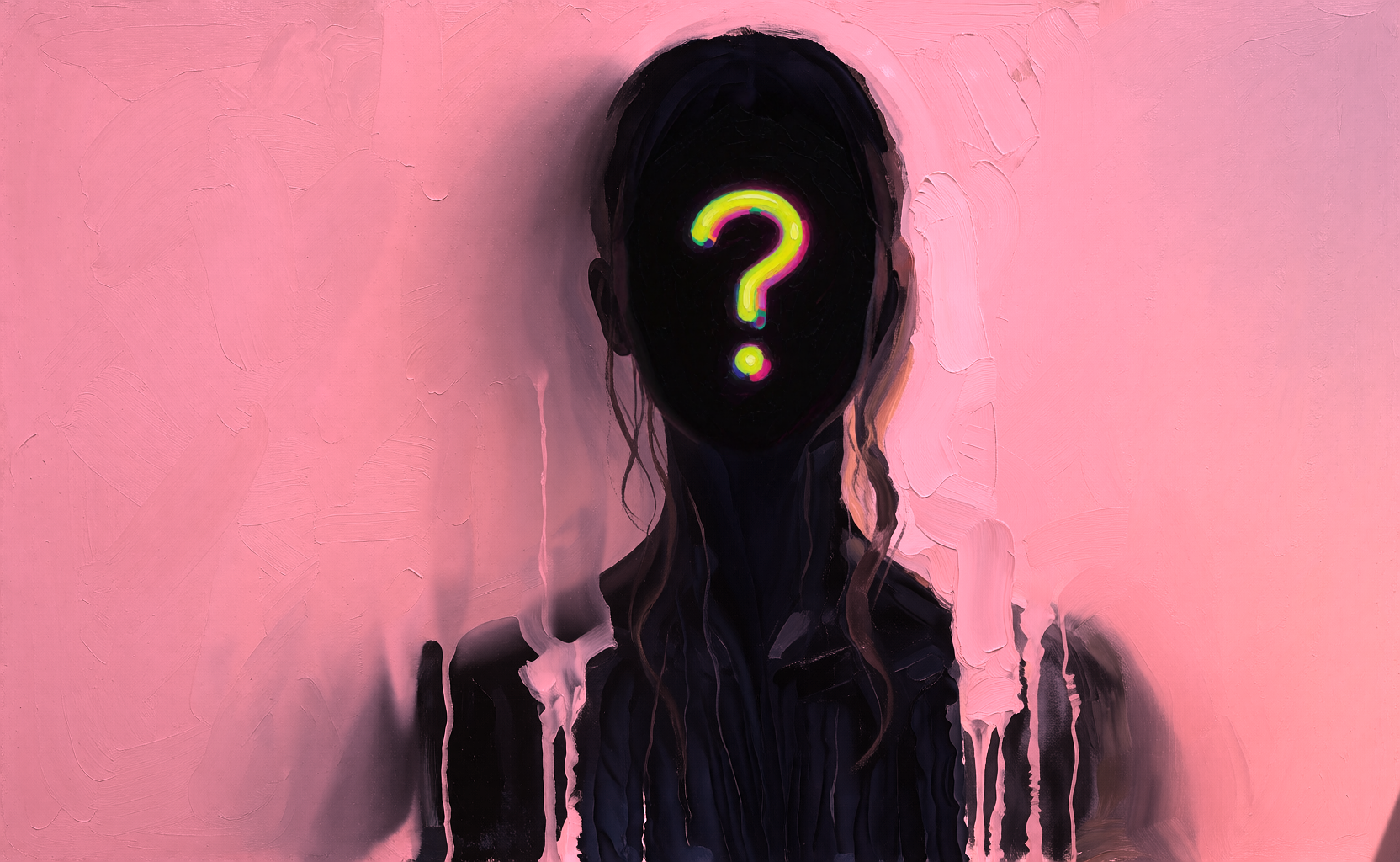
Sarah woke to the sound of rain against the window and the familiar rhythm of David's breathing beside her.
She lay still, watching the shadows move across the ceiling. The faint glow of the humidity monitor on the dresser tinged the room blue. The blankets were warm. Her husband's shoulder rose and fell with each breath, steady.
Handsome, she thought. He looks handsome when he sleeps.
And then, before she could stop it, that unsettling, persistent question came back.
Was that me?
The question surfaced like something floating up from deep water.
She tried to push it back down. She turned her head on the pillow to look at David again.
Forty-three years old, and hair going gray at the temples. The man had a distinct smell that reminded her of pinewood, and she'd woken up to him for almost twenty years. She had loved him for longer.
And yet.
When I look at him, I see him through you.
It responded.
Yes.
The companion didn't have a name. Sarah had never given it one, and it had never asked. It was there, part of everything, like the sun, earth, and wind.
She'd received it at six, the standard age. Her parents had saved for years. "We want you to be able to become the best version of yourself, sweetie. It will help you," her mother had said, "with everything." And it had.
The thing everyone knew was that a companion simply provided "superior context." It was her mind doing the work; the companion was just there to support her by augmenting it with optimized processing, context storage, and retrieval.
Growing up, when she felt anxious before a test, it would gently remind her how hard she had studied. She'd done the work to be confident, and was simply augmenting herself with the system's capacity for contextualized understanding.
When she'd been seventeen, mid-fight with her older sister about something stupid, it had retrieved a memory of them hugging in the hospital, both crying, after the sad, young doctor had come to talk about their dad. The anger hadn't survived it.
And when she met David at that party twenty years ago and felt something spark, it had...
Sarah sat up in bed, slowly, careful not to wake him.
What did you do, she asked the companion, when I met David?
The response came not as words but as fully formed thoughts.
I helped provide additional context.
No, she cut it off. What exactly did you notice? What did you have me pay attention to?
I observed elevated heart rate, pupil dilation, and neurochemical markers consistent with attraction. I cross-referenced his profile with your stated preferences and historical patterns. I noted high compatibility across seventeen dimensions. I provided no intervention.
She confirmed, No intervention?
Correct. The attraction was endogenous. I merely contextualized.
Sarah stared at the dark window. Rain streaked down the glass in silver threads.
What does "contextualized" mean?
When you felt initial uncertainty about approaching him, I surfaced memories of past social successes with men to reduce anxiety. When the conversation stalled, I suggested topics likely to resonate based on his public interest profile. When you wondered whether to give him your number, I modeled probable outcomes and noted that 94% of futures in which you did not resulted in reported regret.
So you didn't make me love him.
I cannot make you feel anything. I can only provide information to help you feel what you would have felt anyway, more clearly and with less interference from noise.
After another half hour awake, she tried to remember the first kiss.
It had been three months after the party. They'd gone to dinner at a small Italian place in the older downtown, candles on the tables and rain outside.
The dinner had been good. The conversation better. She remembered the warmth of the wine, and the way the candlelight caught in David's eyes.
And then, walking back to her apartment, the moment when he'd stopped under an awning to let a rush of rain pass, and she'd stopped too, and they'd looked at each other, and—
She tried to isolate the memory. Tried to feel it as she had then, at twenty-three, looking at a face half-lit by the streetlamp.
But every time she reached for the memory, she found it already wrapped in context. The companion's assessment of his body language (open, nervous, hopeful). The companion's note about her own elevated cortisol (excitement, not fear). The very gentle suggestion she had been given that this was a moment for spontaneity, that hesitation here would create friction, that kissing him was the highest-probability path to outcomes she would later report as positive.
Did she even remember kissing him, or had that been offloaded entirely into her companion?
Sarah slipped out of bed and padded to the bathroom. She closed the door before turning on the light, not wanting to wake David. In the mirror, a tired woman looked back at her. Dark circles under her eyes. Hair flattened on one side from sleep.
When did I start looking so exhausted?
You began showing increased signs of fatigue approximately eighteen months ago, correlating with increased work stress and decreased REM efficiency. I have been adjusting your caffeine recommendations and suggesting schedule modifications to compensate.
I... didn't notice.
That question hadn't been meant to be answered.
You and I have not found it salient. We've prioritized other concerns.
Sarah gripped the edge of the sink.
I want you to stop, she said. For a few minutes. Go silent.
A pause. The companion had never paused before.
That is not recommended. Sudden cessation can cause disorientation and anxiety.
I know. Do it anyway.
Another pause. Longer, this time.
For how long?
Five minutes. I want to see, she thought.
What I am without you.
The silence came like a door in her mind closing.
Maybe it had always been empty.
Sarah looked at the mirror. She looked at... a face.
Eyes, nose, and mouth, arranged in a familiar pattern. Some, but certainly not all, of its familiarity was missing. She dismissed it as disorientation until her attention turned to David.
A shape in a bed. Warm. Breathing. She could remember facts: his name, their history, the scar on his chin. But the facts were inert. They sat in her mind like stones, heavy and cold, unmoving.
She waited for feeling to come.
It didn't.
Two minutes in, Sarah was gripping the sink again so hard her knuckles had gone white. She took one gasping breath in before holding back a sob, her chest tight with dread.
This wasn't the absence of love. This was the absence of everything.
The thoughts she was having were thin, scattered, like leaves blowing across an empty parking lot.
When she tried to think about David, she got: Man. Husband. I have known him a long time. And then nothing.
Was this what she really was? When the tears and halting sobs began, they did not cease.
Who the fuck am I?
Silence.
By three minutes, she was on the floor, clutching her legs tight as she backed into a corner against the wall. She rocked back and forth as she wept.
More silence. Four.
She tried to think a single thought about her husband that was hers alone.
He snores sometimes.
She laughed out of a painful amusement. He did snore. But now she remembered only a man making noise.
Come back, she thought. Please. Come back.
The companion returning felt like sunlight. It filled her mind with more than just memories, but why those memories mattered.
Sarah sagged against the sink, gasping. The world had color again. Meaning again. David was David, not just a shape.
He was her husband. Her partner. A man who brought her coffee in bed on Sunday mornings and always forgot to put the toilet seat down. In the early years of their relationship, when her mother was dying in the hospital not even a decade after her dad, he had stayed up all night with her. He'd said nothing and just held her hand.
She loved him.
But she didn't know whether that love was hers, or a story the companion fed her when it felt relevant.
It offered no answer.
She went back to the bedroom.
David was still asleep, still breathing, still beautiful in the dark. She stood in the doorway and looked at him for a long time.
He has a companion too, she thought. It remained silent.
Almost everyone does. His companion is doing for him what mine does for me. When he looks at me and feels love, is it his?
When we kiss, when we make love, when we fight and forgive and build a life together, how much of that is us? How much is two humans connecting in a way that's theirs alone?
She could wake him up right now, and ask him to silence his companion too. They could see if there was anything underneath.
David stirred but didn't wake. His hand moved on the blanket, reaching for where she should have been. A small, unconscious gesture.
If I tell him, she thought, we will never unknow it. We could spend the rest of our lives wondering what's real. And if I don't tell him, I'll spend the rest of mine wondering alone.
She reached out and touched his shoulder anyway.
"David."
He stirred again. His eyes opened, found her in the dark.
"Hon?" His voice was rough with sleep. "Agh... what time is it?"
"Early." She paused, then hesitantly said, "I need to ask you something."
He pushed himself up on one elbow, rubbing his eyes. "What's up? Something wrong?" he asked.
"I need you to do something," she said. "And I need you to trust me. Even if it sounds crazy."
He nodded.
"Tell your companion to go silent," she said. "Just for five minutes. And I'll do the same."
David stared at her, deeply confused. "What? Why?"
"I want to see what we are. Without them. I want to know if—" She stopped. Swallowed. "I want to know if there's anything underneath."
"Sarah, that's—" He shook his head. "That's not how it works. It's part of our brain."
"Sure."
"So what's the point?" he asked softly.
"I don't know. Maybe there isn't one. Maybe we'll just sit here and feel nothing and then turn them back on and pretend this never happened."
"Then why—"
"Because I need to know!" The words came out louder than she'd intended. She took a breath, holding back tears. "I woke up tonight and... I turned it off. I looked at you and I couldn't..."
She paused, looking into his eyes, preparing for them to show pain. "I tried to have a single thought about you that was mine. Just mine. And I couldn't find one. Every feeling I have about you is... is part of this fucking thing. I don't know if I love you or if I just love the idea of you that it's been showing me."
David was quiet for a long time.
"Okay," he said finally.
"Okay?"
"I'll do it. If you need to see." He reached out and took her hand. "But I want you to know something first. Before it's quiet up there."
"What?"
"I love you. I can't separate what's mine or mixed in from the companion. But whatever this is. This—" He squeezed her hand. "This is real."
Sarah felt tears prick at her eyes.
Is this mine? she wondered. This feeling right now?
They went silent together.
The world flattened. The room became just a room. David's hand in hers became just a warm, dry, callused thing.
She looked at him. He looked at her.
There was nothing.
And then... a flicker.
Recognition. The sense that she knew this person somehow, even without all the words for what that meant.
She watched his eyes search her face. She saw the same confusion there, the same uncertain reaching.
It was different, with him awake. He was there.
He squeezed her hand. She squeezed back.
It was barely anything, but they shared it together. Two mammals in the dark, clinging to each other without fully knowing why.