Theory of Mind
Who owns the infrastructure our cognition is migrating to?
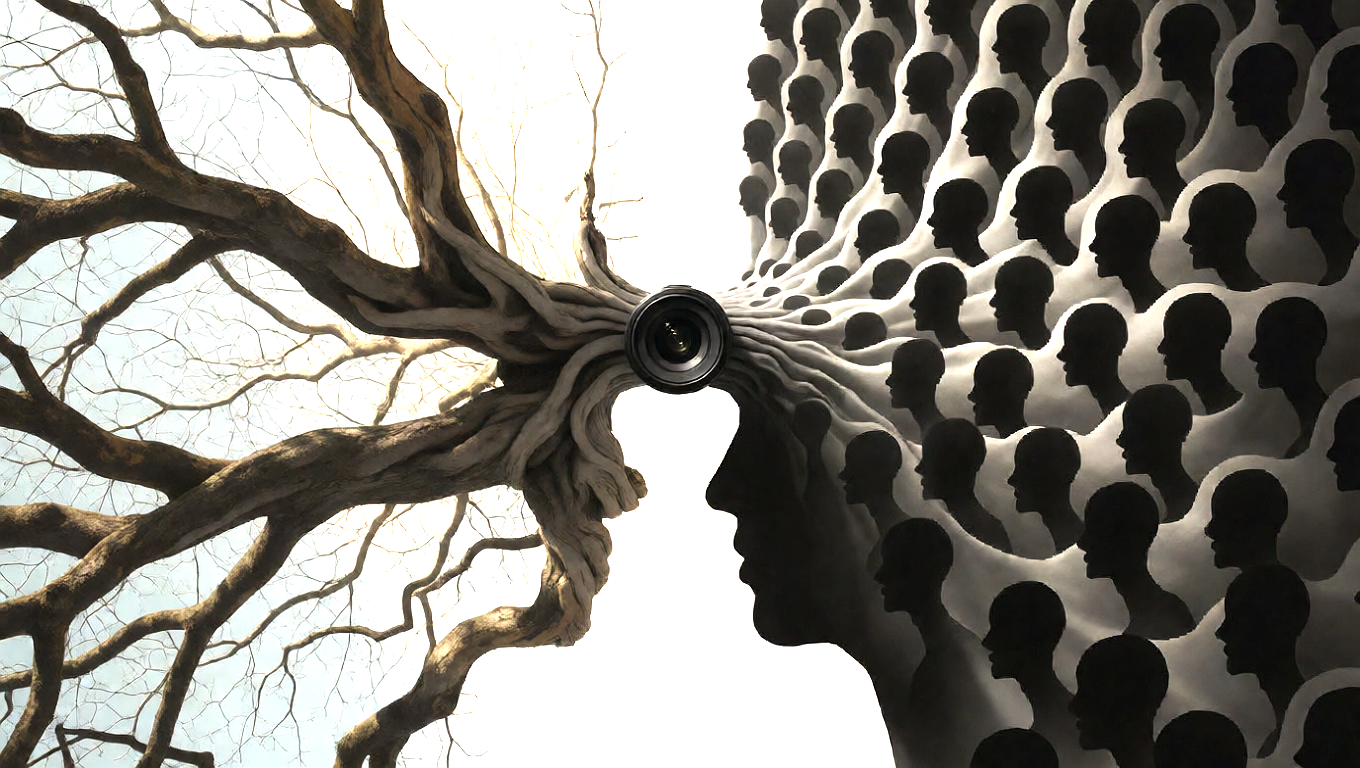
Human beings are born too early.
Compared to other primates, we arrive in the world catastrophically unfinished. A newborn horse stands within an hour, taking its first steps shortly after birth, but a newborn human cannot even hold up its own head for months.
Our skulls grew larger as our brains evolved, but bipedalism narrowed the birth canal. Human babies therefore had to be born earlier, before their brains were fully developed.
What we sacrificed for larger brains and upright posture was developmental completeness. We are born with brains roughly a quarter of their adult size, and we spend the next twenty years finishing the job outside the womb.
This developmental constraint became evolution's greatest invention. Because the brain finishes developing in the world rather than in the body, it is shaped by the world. More specifically, it is shaped by culture, the shared social environment humans create around themselves.
Language isn't installed like software, but absorbed through thousands of hours immersed in a specific community's shared reality. The brain completes itself through others, building its neural architecture from social and cultural input.
That social process now extends far beyond our immediate communities. Much of culture reaches us through information systems that select and manipulate context before we encounter it. LLMs intensify this shift: they contain compressed patterns drawn from civilization's language and increasingly serve as our first source of explanation.
Early humans who picked up a rock never evolved harder fists. The capability didn't vanish, it migrated to the tools available to us as a species, and the body quietly deallocated what it no longer needed to maintain. The same will happen now.
If you solely use AI to write, your independent synthesis and capacity to communicate thought atrophy. Use it to outsource analysis and you stop building the patterns of thinking that analysis requires. The brain recognizes an external resource and redistributes.
We are becoming human-AI cognitive systems. Every time you think "I'll ask Claude" instead of reasoning through a problem alone, you're optimizing your mind by forgetting how to think by yourself.
This redistribution is not necessarily a loss. Cognitive tools have always changed what the mind must do for itself, and children growing up with AI will wire their brains around it just as previous generations adapted to writing, calculators, and search.
The alarmists were always technically correct; for example, our need for memory did change after writing. The species didn't decline into a permanent amnesia, incapable of all memory, but it did leverage the tool widely as a technology of the mind. The freed capacity went somewhere else, toward things the previous tool made newly possible.
AI differs from those earlier tools in one crucial respect: it does not merely store or retrieve information. It participates in deciding what deserves attention and how a problem should be framed. It sits inside the cognitive loop. Its biases function like an agenda, whether or not that agenda is its own.
That means the question is not whether our cognition will increasingly live outside our skulls. It already does, and increasingly will.
The question is who controls the infrastructure our cognition is migrating to—and whose purposes it serves: yours, an authority's, or the imperatives of an engagement-optimized aggregate. This is the difference between a journal and a feed. One extends your thinking. The other replaces it.
We will tether our minds to these systems. The remaining question is how to design them without surrendering independent thought.